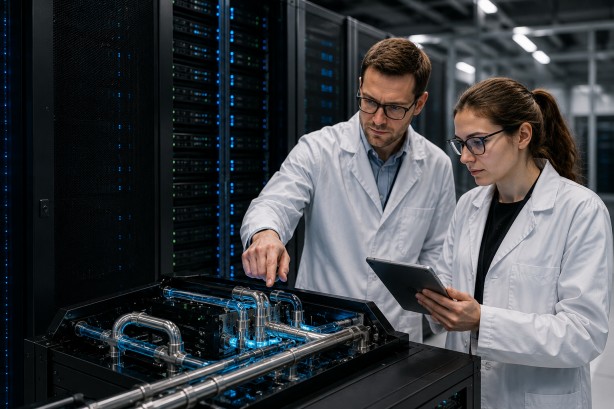
In response to the surging demand for artificial intelligence, researchers in Switzerland are pioneering advanced technologies to enhance the energy and water efficiency of AI data centers. The team, consisting of scientists from the Swiss Federal Institute of Technology in Lausanne (EPFL) and the start-up company Corintis, is focusing on creating liquid-cooling systems that are specifically designed to align with the thermal profiles of individual computer chips. This innovative technology is projected to cut down cooling energy consumption by about 20% while requiring less water than traditional cooling methods.
A significant aspect of this project is the emphasis on reusing the waste heat produced by AI servers. Rather than allowing this heat to dissipate into the environment, the researchers are developing methods to repurpose it for district heating systems during the colder months. Additionally, there are plans to convert a portion of this waste heat back into electricity in the warmer seasons, further optimizing energy use.
The necessity for such liquid-cooling systems is underscored by the fact that AI processors generate considerably more heat than conventional computing systems. This has made efficient cooling solutions increasingly crucial in managing the thermal output of AI technologies. However, while these advancements in cooling are promising, experts caution that they alone are not enough to mitigate the growing environmental footprint of AI. The escalating global demand for AI services continues to drive up electricity and water consumption significantly.
Overall, the development of these cooling technologies marks an important step in addressing the environmental challenges posed by the expanding AI industry. As the research progresses, it highlights the dual focus on improving efficiency and sustainability, aiming to balance technological growth with ecological considerations. The work being done in Switzerland could potentially set a precedent for similar initiatives worldwide, as the tech industry seeks to harmonize its rapid advancements with responsible environmental stewardship.