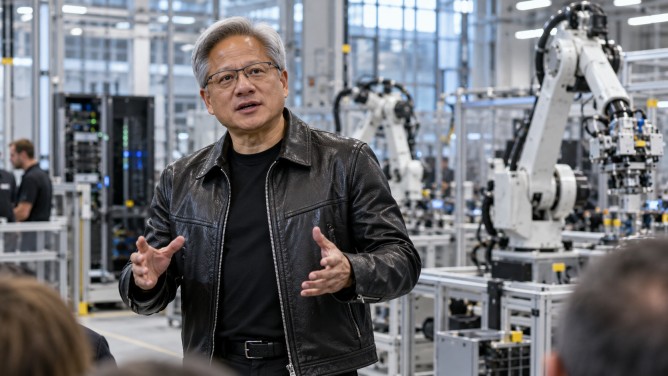
Nvidia CEO Jensen Huang has called on European industries to swiftly embrace artificial intelligence (AI) to enhance competitiveness in sectors such as automotive manufacturing, healthcare, banking, and industrial production. His comments, made during a conference hosted by Nvidia in Berlin, underscore the urgent need for Europe to bolster its position in the global AI race, where the United States and China currently lead.
Huang stressed the importance of integrating AI into various business operations, including product development and manufacturing processes, to unlock its full potential in areas like autonomous driving, robotics, drug discovery, and financial services. The established industrial base in Europe, which includes major players like Germany’s Siemens and France’s Schneider Electric, stands to gain significantly from AI adoption due to their extensive manufacturing operations and access to industrial data.
German Chancellor Friedrich Merz has echoed this sentiment, urging small and medium-sized industrial enterprises to leverage existing data for AI-driven innovation and growth. However, the path to widespread AI adoption is not without challenges. Data security concerns are a significant hurdle, as evidenced by a recent survey of 603 German companies, where 45% of respondents expressed worries about the potential risks of using third-party AI tools that could compromise sensitive commercial information.
In response to these concerns, Huang highlighted Nvidia OpenShell, a security-focused environment designed to maintain AI agents within user-defined boundaries. This initiative aims to address data protection issues as businesses explore AI solutions, balancing innovation with the need for robust security measures.
The focus on AI adoption is part of a broader effort for Europe to maintain its industrial edge in a rapidly evolving technological landscape. As industries continue to explore AI-driven advancements, finding the right balance between innovation and security will be crucial for sustainable growth and competitiveness in the region.